Understanding Poker Hands and Rankings
Poker is one of the most popular and intellectually stimulating card games in the world. Whether you’re playing in a casino, at home, or online, your success largely depends on how well you understand the poker hands and rankings. Knowing which hands beat which, how often they occur, and how to read your opponents’ possible combinations are essential skills that separate beginners from experts. In this detailed guide, we’ll explore the complete hierarchy of poker hands, analyze probabilities, and uncover advanced strategies for mastering Understanding Poker Hands and Rankings in both theory and practice.
The Importance of Poker Hand Knowledge
Understanding poker hands is not just about memorization; it’s about making informed decisions. Every move—calling, raising, or folding—relies on evaluating hand strength. The ranking system exists to determine the winning hand objectively, and grasping it allows you to read the table more effectively. Once you master this foundation, you’ll develop a strategic intuition that enhances your gameplay, even against seasoned opponents.
The Official Poker Hand Rankings
Poker hands are ranked based on rarity and statistical probability. Each hand is formed from five cards, and the less likely a combination occurs, the higher its rank. Below is the official ranking from highest to lowest.
Royal Flush
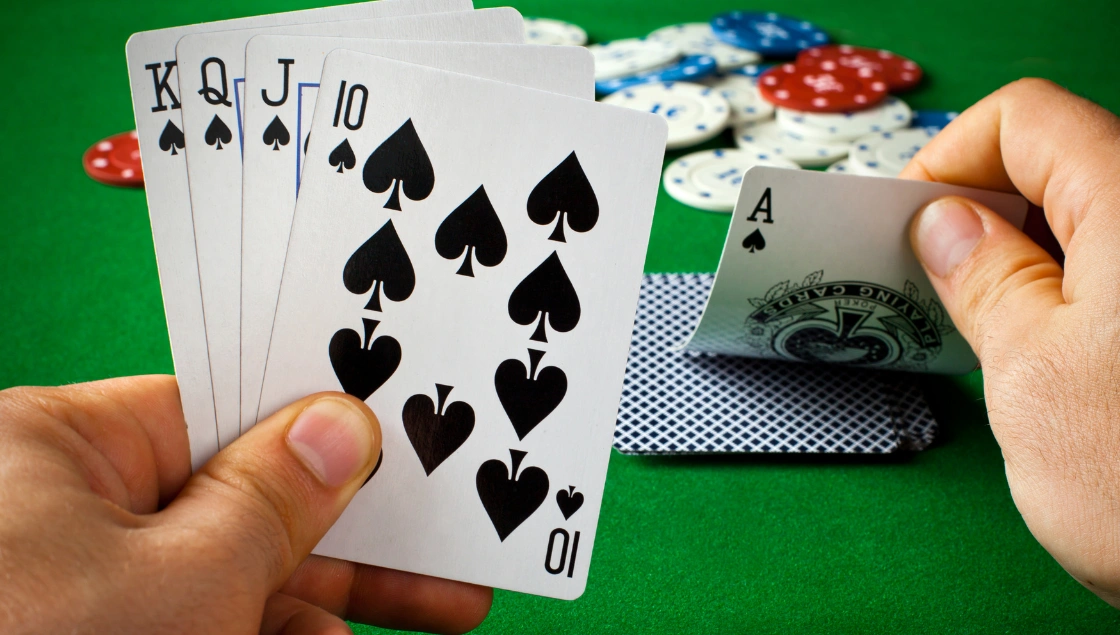
A Royal Flush is the best possible hand in poker. It consists of five consecutive cards of the same suit in the sequence Ten, Jack, Queen, King, and Ace. Example: A♠ K♠ Q♠ J♠ 10♠.
Probability: 1 in 649,740
Key Strategy: When you have a royal flush draw (four suited high cards), play aggressively to maximize potential winnings.
Straight Flush
A Straight Flush consists of five consecutive cards of the same suit, such as 7♥ 8♥ 9♥ 10♥ J♥. It’s the second-highest hand and extremely rare.
Probability: 1 in 72,193
Tip: Even a low straight flush (like 2♣ 3♣ 4♣ 5♣ 6♣) beats any four-of-a-kind.
Four of a Kind
Also called Quads, this hand features four cards of the same rank plus one side card (kicker). Example: 9♦ 9♣ 9♠ 9♥ K♣.
Probability: 1 in 4,165
Play Insight: Quads are nearly unbeatable; slow-play them when possible to lure in opponents.
Full House
A Full House contains three cards of one rank and two of another, like 8♠ 8♦ 8♣ 6♣ 6♥.
Probability: 1 in 694
Tip: Always compare the rank of the triplet first—three Kings full of Jacks beats three Queens full of Aces.
Flush
A Flush has five cards of the same suit but not in sequence, such as K♣ 10♣ 7♣ 6♣ 3♣.
Probability: 1 in 508
Strategic Insight: Flushes are strong but vulnerable to full houses and straight flushes; consider your opponent’s betting pattern before overcommitting.
Straight
A Straight is five consecutive cards of mixed suits, like 5♦ 6♣ 7♠ 8♥ 9♦.
Probability: 1 in 254
Key Point: The Ace can serve as both the highest (A K Q J 10) and lowest (5 4 3 2 A) card, but not simultaneously.
Three of a Kind
Also known as Trips or Set, this hand has three cards of the same rank. Example: 4♣ 4♠ 4♦ 9♥ K♣.
Probability: 1 in 46
Strategy: Hidden trips (a “set”) formed from a pocket pair on the flop are more deceptive than those formed with community cards.
Two Pair
A Two Pair hand includes two different pairs and one kicker. Example: Q♣ Q♠ 8♣ 8♦ 5♥.
Probability: 1 in 21
Tactical Note: The kicker plays a vital role when multiple players hold the same two pairs.
One Pair
The most common winning hand, One Pair, contains two cards of the same rank and three unrelated cards. Example: 10♠ 10♦ 7♣ 5♥ 2♠.
Probability: 1 in 2.36
Tip: Evaluate your kicker strength and position before overvaluing this hand.
High Card
When no combination forms, the High Card determines the winner. Example: A♣ J♦ 8♥ 6♣ 3♠ (Ace-high).
Probability: 1 in 1
Play Advice: High card hands rarely win in multi-player pots; use them primarily for bluffing.
Mathematical Insights Behind Poker Hands
Poker’s foundation lies in mathematics. Every hand’s ranking correlates directly with its statistical rarity. For example:
- There are 2,598,960 possible 5-card hands.
- Only 4 royal flushes exist in total.
- 10 straight flushes per suit, making 40 total straight flushes.
- 624 possible full houses, derived from choosing a triplet rank and a pair rank combination.
Understanding these probabilities gives a competitive edge. If you know how rare your hand is, you can make smarter bets and avoid overplaying mediocre holdings.
Reading Opponents and Table Dynamics
Recognizing hand rankings is just step one. The next stage in mastering poker lies in interpreting opponents’ actions. Every bet tells a story:
- Consistent aggression might indicate a strong made hand.
- Sudden raises can represent a bluff or semi-bluff draw.
- Defensive checks often suggest marginal strength.
Learning to combine statistical logic with psychological analysis transforms your game from mechanical to strategic.
How Community Cards Change Hand Strength
In Texas Hold’em, five community cards alter traditional probabilities. Your hole cards, combined with these shared cards, create seven potential combinations. The goal is to form the best five-card hand possible.
For example:
- Holding A♠ K♠ on a flop of Q♠ J♠ 10♠ gives a Royal Flush.
- Holding 9♠ 8♠ with a flop of 7♠ 6♠ 5♠ makes a Straight Flush.
- However, a flop of paired cards like 10♦ 10♠ 4♣ could improve to Full House territory if you hold a matching rank.
The changing nature of community cards demands flexibility in evaluating hand strength as the board evolves.
Position and Hand Value
Even a top-ranking hand’s value changes based on table position. Early position players act first, facing more uncertainty, while late position players can assess others’ moves before deciding.
Tips for applying hand rankings by position:
- Early position: Play only premium hands (high pairs, strong suited connectors).
- Middle position: Expand range slightly but stay disciplined.
- Late position: Use position to control the pot with mid-level hands and well-timed bluffs.
Common Mistakes in Evaluating Poker Hands
Even experienced players misread hands or overestimate their strength. Avoid these pitfalls:
- Confusing flushes and straights when suits differ.
- Ignoring kicker influence in ties.
- Overvaluing medium pairs in multi-way pots.
- Misjudging board textures, like paired flops or coordinated suits.
Accuracy in hand reading is crucial for long-term profitability.
Practical Application: Building Hand Ranges
Advanced players don’t just think in single hands but in ranges—sets of possible hands opponents might hold.
When someone raises pre-flop, they likely have:
- Premium hands: A-A, K-K, Q-Q, A-K suited.
- Strong draws: J-10 suited, 9-8 suited.
- Occasional bluffs: Low suited connectors or weak aces.
By narrowing ranges through betting patterns, you can estimate the probability of specific hand categories and make data-backed decisions.
Real-Life Examples of Poker Hand Scenarios
- Scenario 1: Top Pair vs. Flush Draw
You hold A♣ K♣ and the flop comes K♦ 8♣ 3♣. You have top pair and a nut flush draw. Here, understanding that your hand can evolve into a top-tier flush helps justify aggressive play. - Scenario 2: Full House on the River
You hold 7♠ 7♦ with a board of 7♣ 10♦ 10♠ 2♥ 2♣. This forms a Full House (Sevens full of Tens). Recognizing it outranks a simple Flush or Straight can protect you from folding prematurely.
FAQs about Poker Hands and Rankings
Q1. What happens if two players have the same hand?
If two players share the same ranked hand, the kicker card determines the winner. If both have identical kickers, the pot is split.
Q2. How often should I play lower-ranked hands like one pair or high card?
Use these hands strategically. One pair can win in heads-up play but should be folded in crowded pots unless strongly supported by position or reads.
Q3. What’s the difference between a set and trips?
A set is formed when you have a pocket pair that matches a community card. Trips occur when two community cards match one of your hole cards. Sets are harder to detect and therefore more profitable.
Q4. Is it better to memorize or calculate hand rankings?
Memorization helps initially, but deeper understanding—such as how board textures affect outcomes—makes you adaptable in real games.
Q5. Can a straight flush start with an Ace?
Yes, but only as A-2-3-4-5 (known as a wheel). A-10-J-Q-K would be a Royal Flush, the highest possible hand.
By fully grasping Understanding Poker Hands and Rankings, players can elevate their decision-making, adapt to changing table dynamics, and consistently make profitable plays. Poker is not just about luck; it’s about logic, observation, and understanding the mathematical and psychological structure that underpins every hand.